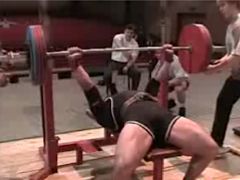
 This week saw the birth of 2007, a cricket whitewash (for the first time in 86 years) and the following stories here on Straight to the Bar :
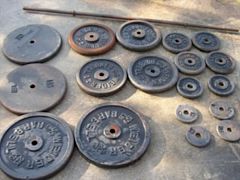
- Glossary - strength training equipment : before this month's article series on training equipment gets into full swing, a few key pieces of strength training equipment were defined. This will undoubtedly become part of a much larger, growing resource.
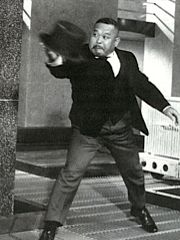
- Harold Sakata : a fascinating bio of the Olympic weightlifter and professional wrestler who is perhaps best known to most as Oddjob - Goldfinger's golf caddy and manservant.
- Top 5 weightlifting injuries : watching these was a bit like slowing down to see a car accident. Slightly nauseating, but very difficult to resist.
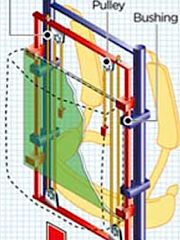
- Bungee backpack : with a reduction in the force felt by the wearer of up to 86%, this backpack looks set to be in the arsenal of long-distance hikers and runners everywhere.
- Virtual Meet : the first 'Geographically dispersed powerlifting meet' is only a matter of weeks away. Get ready.
 Saw this mentioned in several places, the first of which was
  Summer, Sydney and
 This month's article collaborations with
 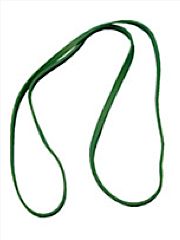 bands : along with chains, bands are the usual method of employing 'accommodating resistance'. This simply means that the weight gradually increases throughout the concentric part of the lift; as well as making the eccentric part a little more difficult.
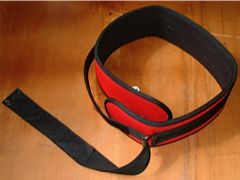 belt : a weight belt serves two main purposes [1]. The first is to reduce stress on the lower back whilst the lifter is working in an upright position, the second is to prevent hyperextension of the back during overhead lifts.
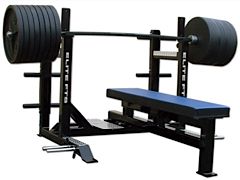 bench : along with the power rack, the bench forms the hub of many a home gym. If you're wondering why you can't simply lie on the floor for your pressing work, you can; the bench, however, affords a greater range of motion and allows for the benefit of leg drive.
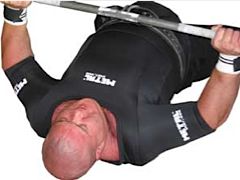 bench shirt : this is an item used by some powerlifters (it's why you'll hear things such as a 'shirted bench'). The bench shirt is a tight, dedicated garment which acts much like a rubber band - making it a little more difficult to pull the bar down to your chest, but easier to press the bar back up again. A shirted bench is typically 100lb or more above a raw (or unshirted) bench.
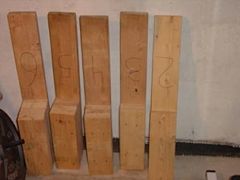 boards : boards are used for
 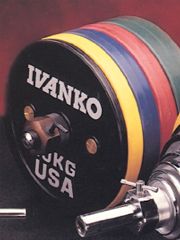 bumper plates : these are used (usually in conjunction with a lifting platform) for Olympic lifting. They can either be rubber coated or completely made from rubber, and are calibrated, quality plates that are made to take a little more abuse (from dropping) than regular plates. Note that this dropping is generally from knee height or below.
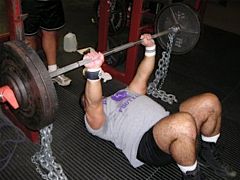 chains : like bands, chains offer accommodating resistance. A common use is with the bench press, where they are draped over the ends of the bar so that only a small portion rests on the floor. As the bar is lowered, this amount increases (gradually increasing the weight being lifted); lowering again as the bar is pressed.
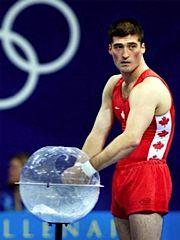 chalk : a grip aid. This works largely by keeping the palms dry and is usually used (in strength training) on exercises such as the deadlift, and the Olympic lifts.
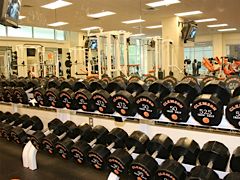 dumbbells : whilst various hand-held weights have been around for a long time, dumb-bells as we now know them are a reasonably recent invention (only a few hundred years or so). Initially, many of these were made by taking two small bells, removing the clappers and affixing the bells to the ends of a bar. They were quite literally dumb bells.
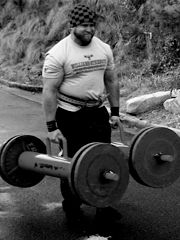 farmer's walk implements : one of the exercises often associated with Strongman training (although it is now used reasonably widely) is the Farmer's Walk; walking a set distance with a heavy object in each hand. Whilst many things are used for this exercise - including the humble dumbbell - it is usually performed in Strongman competitions using a pair of Farmer's Walk implements (pictured). If you've never used them before, think dumbbells on steroids.
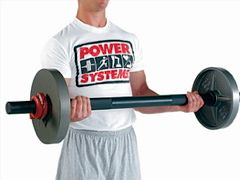 fat bar : nothing terribly complicated here. A fat bar is no more than a thicker version of a standard bar (2 or 3 inches rather than the usual 1 or so). The extra diameter makes it slightly more difficult to hold; providing an additional grip requirement for each exercise.
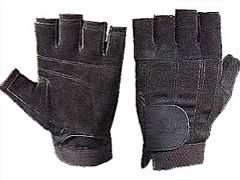 gloves : weightlifting gloves (usually fingerless) simply work to increase your grip. As with belts, these are often used - if at all - only for the heaviest set or two.
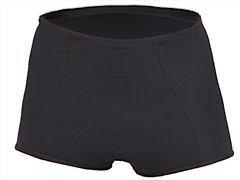 groove briefs : think of them as underwear for your squat suit. Briefs increase hip drive, reduce groin pain (helping you to train through minor injuries) and add to overall stability. Not to mention making putting on your squat suit a little easier.
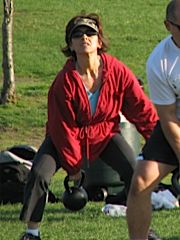
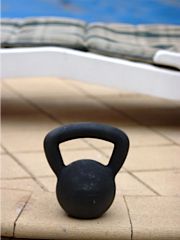 kettlebells : offering an incredible variety of exercises (similar to dumbbells in many ways, with a few bonus features), kettlebells are the ultimate in simplicity. A chunk of iron was never so much fun.
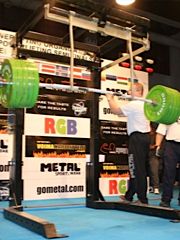 monolift : most notably used by competitive powerlifters, a monolift is a simple mechanical device which takes the walkout away from the squat. The lifter is able to establish their favoured stance beneath the bar (without supporting its weight), before the machine removes its support leaving the lifter to squat as usual.
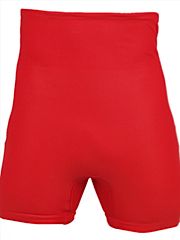 power pants : think of these as the bottom half of a squat suit, with many of the same benefits.
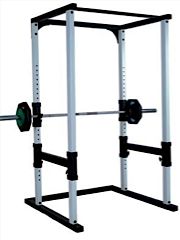 power rack / power cage : a power rack provides a great environment for training numerous exercises in comparative safety. The pins (horizontal bars in the sides of the rack) can be easily moved to several heights, enabling the training of a given exercise through a specific range of motion.
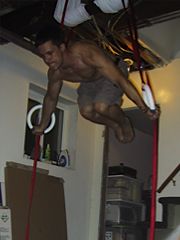 rings : when it comes to upper body strength, ring training delivers in spades. The setup is simple - two rings, each a little larger than a hand, are suspended via long straps. Much more difficult than they look.
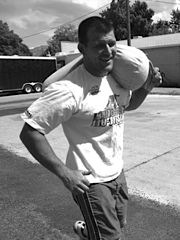 sandbag : exactly what it says - a bag of sand. Large, heavy and difficult to grab hold of - perfect.
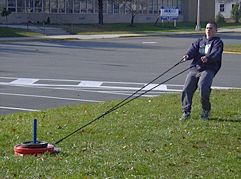 sled : a platform designed to carry various heavy objects, towed by a rope or equally strong strap. Most commonly tied to the waist when running, it can also be dragged in truck pulling style.
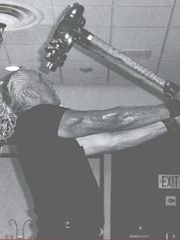 sledgehammer : used for levering (pictured), holds and conditioning work. Excellent for building wrist strength.
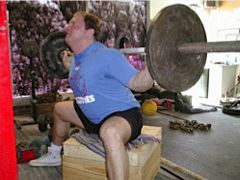 squat box : a box squat (which is actually the search term that
 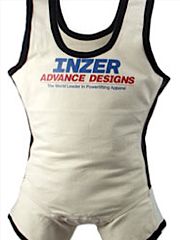 squat suit : functioning in much the same way as a bench shirt, a squat suit essentially makes squatting a little more difficult on the way down and assists on the way up.
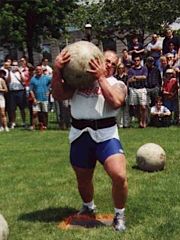 stones : if you've ever watched a Strongman competition, chances are you've seen people pick up a series of heavy stones. Whilst these go by several names, they share the simplicity of being a large, heavy, difficult object to lift. Great to watch.
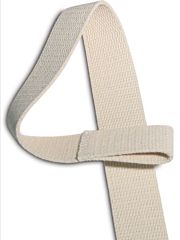 straps : these reduce the need for grip strength in a number of exercises (most things involving a bar) by shifting the supporting role up to the wrists. They're most commonly seen in use with exercises such as shrugs, deadlifts and rows.
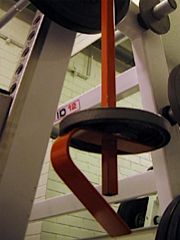 weight releasers : these perform a simple function; most commonly used with the bench press, they add weight at the start of the lift and fall off (under control, of course) when the bar is near enough to the floor. This 'drop off' height is adjustable, enabling targeting of sticking points.
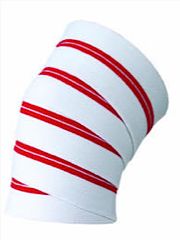 wraps : wraps are usually used to support the knees when squatting, and sometimes the elbows or wrists during exercises such as the bench press. They provide support (whilst allowing sufficient flexibility to perform the exercise) and - in some cases - heat.
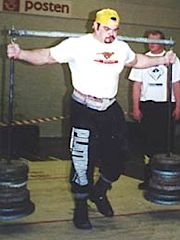 yoke : Norwegian Strongman
  Whilst you may be familiar with
  A
A  T-Nation has an